As e-commerce businesses in Vietnam expand across multiple platforms, consolidating and processing accounting data through traditional methods is becoming increasingly complex. Fragmented data requires businesses to spend considerable time reconciling income and expenses, while growing transaction volumes increase the risk of discrepancies and data omissions.
To manage these accounting activities effectively, businesses need to establish a consistent e-commerce accounting process before gradually transitioning to automated accounting. This article examines the key stages of the e-commerce accounting process and how accounting automation can support businesses operating across online marketplaces.
1. What Is E-commerce Accounting?
In the context of online business operations, e-commerce accounting can be understood as the application of accounting requirements and principles to business activities conducted through e-commerce platforms, including the collection, processing, verification, recording, and provision of accounting information in accordance with Accounting Law No. 88/2015/QH13. In substance, these activities remain subject to general accounting principles; however, data generated by e-commerce businesses is often more complex because it originates from multiple platforms, sales channels, and transaction types, requiring businesses to organize and reconcile the data consistently.
2. What is the Key Stage of an E-commerce Accounting Process?
Vietnamese law does not prescribe a separate accounting process specifically for e-commerce businesses. However, based on general accounting requirements and the characteristics of data generated by online sales platforms, businesses may prioritize several accounting activities, from data collection and payment reconciliation to cost classification, e-invoice processing, and data verification. The following five stages can serve as a reference framework for an e-commerce accounting process.
2.1. Collecting and Standardizing Multichannel Sales Data
The first stage of an e-commerce accounting process is to consolidate data from different sources and standardize it within a consistent structure. Key information to be managed may include:
-
Order ID, transaction date, and order status.
-
Transaction value, currency, and applicable exchange rate.
-
Revenue, refunds, marketplace fees, advertising costs, and other adjustments.
-
Platform, storefront, and account information associated with the transaction.
Once standardized, the data can be mapped to the business's chart of accounts according to its accounting policies. This provides the basis for reconciling revenue, costs, and payments in subsequent stages.
2.2. Reconciling Revenue and Actual Cash Receipts
The total sales value reported by the marketplace does not necessarily correspond to accounting revenue, nor does it equal the amount actually received by the business. Businesses should separately reconcile order values, refunds, marketplace fees, taxes collected or withheld by the platform, adjustments, held balances, and actual payments received. Revenue and expenses should be recognized based on the substance of the underlying transactions, the applicable accounting policies, and supporting documentation, rather than solely on the marketplace payout report.
2.3. Classifying Marketplace Fees
When selling through e-commerce marketplaces such as Amazon and Etsy, businesses may incur multiple fees from different sources, which can make cost tracking more difficult. To maintain a complete and transparent view of costs, businesses should classify fees according to their nature and purpose rather than relying solely on the amount received from the marketplace. This provides a clearer view of the overall cost structure and supports more consistent e-commerce accounting.
2.4. Issuing and Monitoring E-invoices
Once order data has been consolidated and verified, businesses need to use transaction information to issue and monitor e-invoices in accordance with applicable requirements. This stage connects sales data with accounting documentation and helps ensure that business transactions are properly recorded.
Under Decree No. 254/2026/ND-CP, businesses must determine the appropriate timing for issuing e-invoices and the information required on each invoice based on the relevant transaction. Accordingly, the process generally begins with reviewing order data, determining the information required for invoicing, issuing the e-invoice, and monitoring its status after issuance.
2.5. Reconciling Accounting Data and Maintaining Supporting Documentation
After sales, revenue, cost, and payment data have been recorded, businesses need to reconcile the information before closing the accounting period and preparing financial reports. The objective of this stage is to identify unreconciled transactions, investigate discrepancies, and ensure that accounting records are supported by sufficient documentation.
The reconciliation process generally focuses on reviewing unmatched transactions, examining adjustments, and tracing source data when discrepancies arise. Once the review is completed, relevant documents and data should be maintained by accounting period for future retrieval.
In addition, accounting entities are responsible for maintaining accounting records in accordance with Article 41 of Accounting Law No. 88/2015/QH13. Systematic document retention enables accounting teams to retrieve transaction data, payment records, and related documentation when required for review or reporting. However, as transaction volumes increase, manually reconciling and maintaining data across multiple sources can become a significant bottleneck in the accounting process.
Read also: Electronic Invoice Retention: Retention Periods and Requirements
3. What Is Automated Accounting?
Automated accounting refers to the use of software to automate accounting activities such as data collection, classification, reconciliation, and recording. For e-commerce businesses, automated accounting is particularly suitable for high-volume, repetitive activities, such as synchronizing sales data, classifying marketplace fees, reconciling revenue with actual cash receipts, and monitoring e-invoices.
Automated Accounting Roadmap by Implementation Stage
Businesses do not necessarily need to implement automated accounting across the entire process from the outset. Implementation can be structured in stages based on transaction volume, data quality, and the existing accounting system.
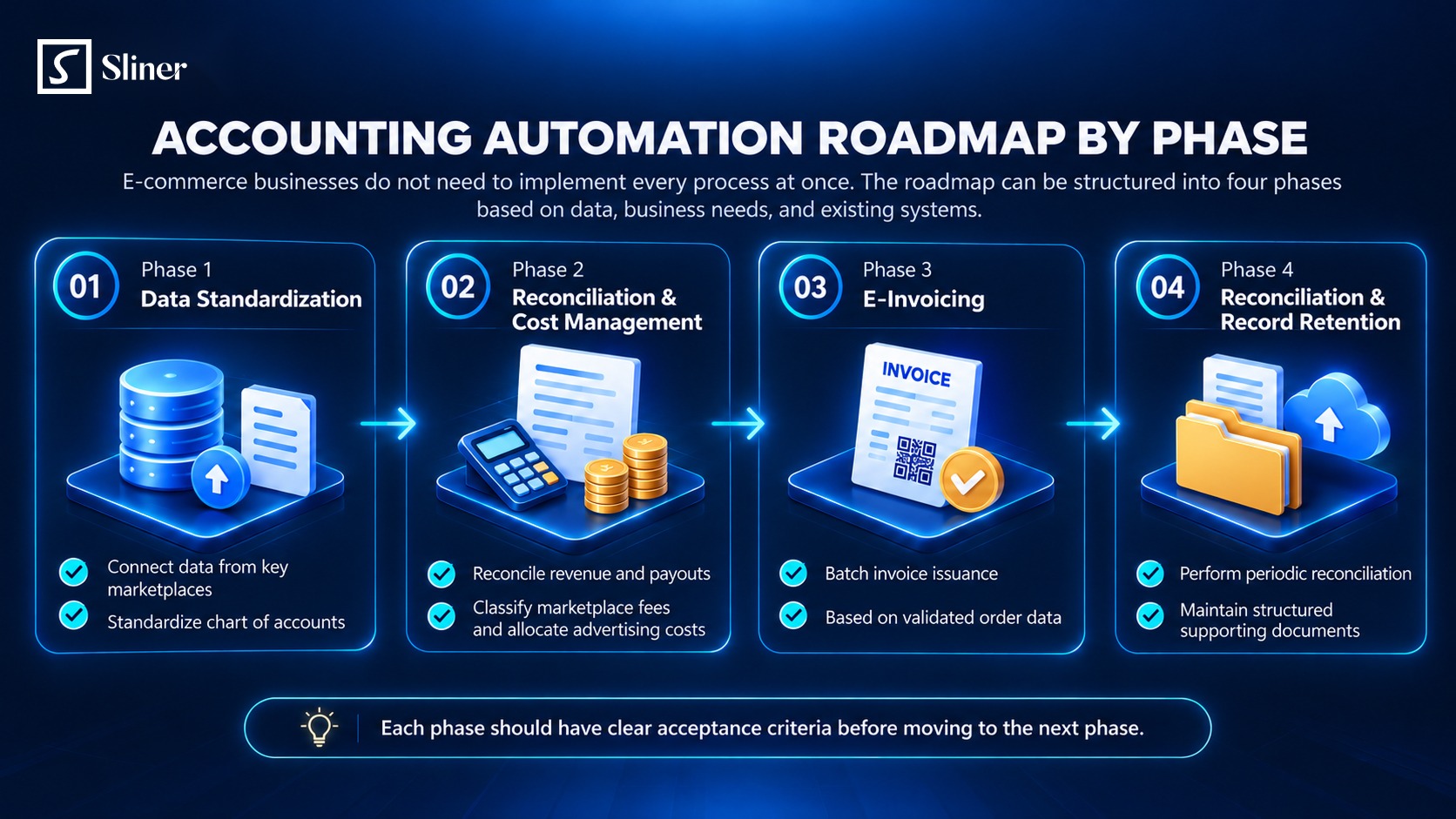
The sequence shown in the accompanying image is for reference only. Businesses should establish validation and acceptance criteria for each stage before proceeding to the next, rather than implementing automated accounting across the entire process simultaneously.
4. How Does Automated Accounting Optimize the E-commerce Accounting Process?
The value of automated accounting does not lie in replacing accounting activities in their entirety, but in connecting individual processing stages into a unified data workflow. When automated accounting is applied to e-commerce marketplace operations, businesses can reduce repetitive tasks, standardize data, and allocate more time to reviewing and addressing transactions that require further attention.
In practice, automated accounting software such as Genbook can support businesses across key accounting activities, including:
-
Reducing manual data entry and data consolidation: Data from multiple platforms can be connected or imported into the system using a standardized structure, reducing the need to repeatedly download reports, copy information, and re-enter data. This is particularly valuable when collecting and standardizing data from multiple sales channels.
-
Standardizing and supporting data reconciliation: When transactions are processed according to consistent rules, businesses can reconcile revenue, actual cash receipts, and marketplace fees within a single system. Unmatched items can then be identified for further review, allowing accounting teams to focus on the underlying causes rather than manually reviewing individual transactions.
-
Improving cost and business performance control: Classifying marketplace fees, advertising costs, refunds, and other adjustments within a consistent structure enables businesses to maintain a more comprehensive view of operating costs. When combined with cost of goods sold and other relevant expenses, this provides a stronger basis for evaluating business performance by product or sales channel.
-
Supporting invoice and accounting documentation processes: Once order data has been standardized and verified, an automated accounting system can support invoice data generation, batch issuance, and status monitoring. Transaction reports, payment records, and adjustment histories can also be maintained in a structured format to facilitate reconciliation.
Accordingly, automated accounting can be implemented progressively by accounting activity rather than requiring businesses to transform the entire process at once. Businesses can begin with high-volume, repetitive tasks and subsequently expand automation to reconciliation, cost control, invoicing, and reporting based on their operational requirements.
Selecting an Automated Accounting Solution for E-commerce Businesses
Identifying the processes that can be automated is the first step in selecting an appropriate solution. Implementation should be based on the quality of existing data, the priority assigned to each accounting activity, and the system's integration capabilities. These factors provide the basis for developing an accounting automation roadmap aligned with operational requirements and available resources.
Sliner Consulting supports businesses selling on Amazon and Etsy in reviewing their accounting processes, identifying priority activities, and developing appropriate implementation approaches. In combination with the Genbook platform, businesses can apply automated accounting to revenue and cost recording and reconciliation. In addition, GenInvoice supports order data synchronization, as well as batch creation and issuance of e-invoices.
Explore Accounting Automation Services or contact Sliner to discuss a solution aligned with your business model and implementation requirements.