.svg)
Amazon payouts are affected by more than marketplace fees, advertising costs, refunds and reimbursements. Since July 1, 2025, Amazon has also withheld, reported and remitted certain taxes on behalf of individuals and household businesses identified as being located in Vietnam. If the legal information in a selling account is inaccurate or tax reports are not reconciled with sales, Sellers may struggle to explain differences between recorded revenue, cash received and their final annual tax position.
Amazon withholding tax should therefore be managed as a separate tax data stream. It should not be grouped with marketplace fees or recorded as a reduction in revenue. Businesses need to understand who is subject to withholding, which data Amazon uses, how the deduction is calculated and how tax paid on the Seller's behalf is treated when the annual tax position is determined.
1. What is Amazon withholding tax?
Amazon withholding tax is used in this article as a shortened term for the mechanism under which Amazon deducts value-added tax (VAT) and personal income tax (PIT) from transactions involving Vietnam-based Sellers, then reports and remits those amounts to the Vietnamese tax authority on their behalf. In this context, “tax withholding” refers to Amazon retaining the applicable tax before paying the Seller, while “withholding tax” is the name of the mechanism through which tax is deducted at the source of payment; these are not two different types of tax. Amazon refers to this mechanism as Vietnamese withholding tax (WHT). It is not a new tax created by Amazon and is not a marketplace service fee.
The mechanism is based on Decree No. 117/2025/ND-CP, effective July 1, 2025. The decree requires qualifying domestic and foreign ecommerce platform operators with online ordering and payment functions to withhold, file and pay tax on behalf of household and individual businesses. The Government's 2026 guidance confirms that this responsibility continues under Article 11 of Decree No. 68/2026/ND-CP.
The distinction is important. Withholding tax on Amazon (Amazon Withholding Tax – WHT) describes the platform's transaction-level process of deducting and remitting tax, while the Seller's final tax liability depends on its records, aggregate revenue and applicable tax method. A deduction shown in an Amazon report does not mean that all filing, annual finalisation or refund requirements have been completed automatically.

2. Who is subject to Amazon withholding tax?
According to Amazon's frequently asked questions, individuals and household businesses identified as being located in Vietnam may be subject to withholding on sales generated across Amazon stores, including sales to customers outside Vietnam. Correct account classification therefore directly affects Amazon withholding tax.
2.1. Individuals and household businesses in Vietnam
Amazon states that the mechanism applies to individual or household business Sellers located in Vietnam, regardless of a VAT or PIT exemption that may affect the Seller's final tax position. This approach enables transaction-level withholding but may create a difference when the annual tax obligation is subsequently determined using aggregate revenue.
From 2026, Decree No. 68/2026/ND-CP, as amended by Decree No. 141/2026/ND-CP, governs tax policy and administration for household and individual businesses. Official guidance on the new rules explains the VND500 million annual revenue threshold and the corresponding filing and payment methods. Sellers should aggregate Amazon revenue with revenue from other channels when determining their annual tax position instead of relying only on the amount withheld by Amazon.
2.2. Vietnam-incorporated companies
Amazon states that a corporate Seller is not subject to Amazon withholding tax when Amazon has verified its legal entity name, Vietnamese tax identification number and Enterprise Registration Certificate. This treatment requires the information in the selling account to match the Seller's legal records.
Exclusion from the mechanism for individuals and household businesses does not mean that a company is tax-exempt. The company must continue to assess VAT, corporate income tax, invoicing and other obligations under the rules applicable to legal entities. If Amazon continues to withhold tax after the corporate information has been verified, the Seller should review its business type and request support from Amazon instead of automatically recording the deduction as a final tax expense.
2.3. Which data does Amazon use to determine a Seller's location?
Amazon does not rely on the country selected when an account is opened. The platform may use billing information, bank account details, credit card information, ship-from addresses, shipping templates and identity information in Seller Central. A corporate account that still contains inconsistent personal banking or address information may be asked to complete additional verification or may be classified differently from the Seller's expectation.
The legal status shown on Amazon should reflect the entity that sells the goods, receives the funds and reports the tax. This alignment is the first step in limiting incorrect deductions and makes it easier to reconcile Amazon withholding tax later.
3. How does Amazon calculate and withhold tax?
3.1. Unadjusted gross sales as the calculation base
According to Amazon, the Amazon tax calculation starts with unadjusted gross sales, meaning total sales before selling fees, fulfillment fees, advertising costs or other charges are deducted. The withholding amount is therefore not calculated directly on the net payout transferred to the Seller's bank account.
For example, if an order records 100 currency units in sales and 25 units in Amazon fees, the withholding base is not automatically reduced to 75. Amazon determines the tax on transaction revenue according to the classification of goods or services and the customer's location, while platform fees are reported separately in settlement data. If accounting records use only the net payout as revenue, both sales and Amazon withholding tax may be understated.
3.2. Withholding rates currently disclosed by Amazon
The table below summarises the rates disclosed by Amazon for Vietnamese individual and household business Sellers. The percentages apply to unadjusted gross sales for the relevant transaction category.
|
Revenue and transaction type |
Value-added tax |
Personal income tax |
|
Goods sold to customers in Vietnam |
1% |
0.5% |
|
Transportation and services associated with goods sold to customers in Vietnam |
3% |
1.5% |
|
Goods sold to customers outside Vietnam |
Not applicable under Amazon's table |
0.5% |
|
Transportation and services associated with goods sold to customers outside Vietnam |
Not applicable under Amazon's table |
1.5% |
|
Fully verified Vietnam-incorporated company |
Amazon WHT mechanism not applicable |
Amazon WHT mechanism not applicable |
This table reflects the information provided by Amazon for sales conducted through the platform and does not replace the full rate schedule under Vietnamese tax law. Businesses should not assume that “services associated with goods” includes every standalone service. Incorrect transaction classification can lead to an incorrect Vietnamese withholding tax rate.
3.3. Withholding timing, cancellations and returns
Under Decree No. 117/2025/ND-CP, withholding is linked to the point at which a transaction is confirmed as successful and payment is accepted. If a transaction is cancelled or returned, the platform may offset tax previously withheld and remitted on the Seller's behalf against tax arising from other transactions. A monthly report may therefore include both new deductions and adjustments relating to an earlier period.
When reviewing the Amazon tax calculation, Sellers should reconcile by order identifier and transaction date rather than comparing only the total for a settlement period. Differences may result from refunds, currency conversion, tax adjustments or an order being reported in a different period from its payout.
4. How to update Amazon tax information
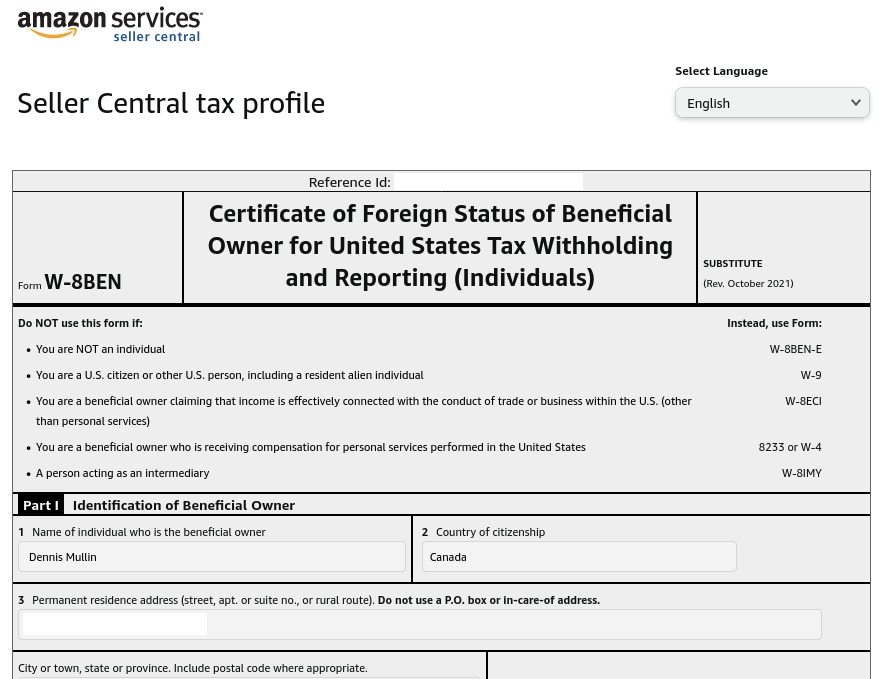
Sellers should update Amazon tax information accurately so that the platform can identify the correct Seller type and reduce repeated verification requests. In Seller Central, go to Account Settings → Account Info → Business Information → Legal Entity.
4.1. Corporate Sellers
According to Amazon's guidance, a corporate Seller should:
-
Select Update Now and confirm the correct Business Type.
-
Enter all requested information and the 10-digit Vietnamese tax identification number in the Company Registration Number field.
-
Review the primary contact information, save the record and select Submit for verification.
-
Ensure that the legal entity name matches the Enterprise Registration Certificate, bank account and tax records.
4.2. Individual and household business Sellers
An individual Seller should go to Primary Contact Information, enter the 12-digit personal identification number under Identity Proof, then save the information and submit it for verification. This is consistent with Vietnam's use of personal identification numbers in place of tax identification numbers from July 1, 2025, provided that the population and tax registration data match.
Amazon's frequently asked questions do not provide a separate, complete process for every household business structure. If the account displays an unsuitable legal type, the Seller should contact Selling Partner Support before making unsupported changes to legal information. To update Amazon tax information correctly, the legal name, business type, receiving bank account and verification documents must all identify the same taxpayer.
5. How to review and reconcile Amazon withholding tax
5.1. Review deductions at transaction level
Amazon directs Sellers to Payments → Reports Repository → Transaction View to review withholding amounts. Sellers should download the data by reporting period and retain the order identifier, transaction date, marketplace, amount type, currency and tax amount.
A practical process to reconcile Amazon withholding tax is to:
-
Match unadjusted gross sales to the order report.
-
Separate sales to customers in Vietnam from sales to customers outside Vietnam.
-
Separate goods from transportation or services associated with goods.
-
Calculate the expected tax using the rate applied by Amazon.
-
Compare the expected amount with Transaction View and the net payout.
-
Record VAT, PIT, Amazon fees, refunds and adjustments in separate accounts.
5.2. Reconcile the annual report with the tax obligation
Amazon states that it will provide documentation of WHT amounts in an annual statement. This report should be reconciled with total revenue across all Amazon stores and the accounting ledger, rather than with only one marketplace. Specialist Amazon accounting separates revenue, fees, taxes and payouts so that the net cash received is not incorrectly recorded as revenue.
Under the guidance implementing Decree No. 68/2026/ND-CP, certain household and individual businesses must aggregate revenue and complete an annual PIT finalisation. PIT withheld and paid by the platform is credited when the final amount payable is determined. If annual revenue falls within the non-taxable range but tax has already been withheld, the tax refund procedure for ecommerce platform activities may be considered after the platform completes its annual filing and remittance obligations.
5.3. Resolve a rate or document mismatch
If the amount withheld by Amazon differs from the expected amount, the Seller should review the account type, addresses, banking information, customer market, transaction category and refund status. If the underlying information is correct but the rate or documentation remains inconsistent, use Amazon's Contact Us form, select Selling on Amazon, and describe the issue with the WHT form in detail.
Sellers should not reduce the tax reported in a return solely because a support case has been opened with Amazon. Transaction reports, annual statements, support correspondence and adjustment entries should be retained as evidence of the process used to reconcile Amazon withholding tax.
6. Reconcile Amazon WHT before the next tax filing
Tax withheld by Amazon does not mean that a Seller has completed all tax obligations. Individuals, household businesses and companies need to reconcile the tax withheld with revenue, legal status, transaction reports and filing obligations under the current regulations.
Sliner supports Amazon Sellers in reviewing their account type, reconciling revenue with tax withheld by the platform, and standardising transaction data for tax filing, annual finalisation or refund procedures where eligible.
Learn more about Corporate Structuring and Tax Planning or contact Sliner directly for advice based on the Seller's specific circumstances.