.svg)
On 31 July 2026 (1 August Vietnam time), US President Donald Trump signed an executive order adjusting "reciprocal" tariff rates for dozens of countries, with new rates ranging from 10% to 41%. Notably, the US administration also announced an additional 40% tariff on any goods determined to be "transshipped" for the purpose of duty evasion. This indicates that Washington's focus is no longer only on imposing higher tariffs, but on tightening the verification of goods origin and blocking trade evasion.
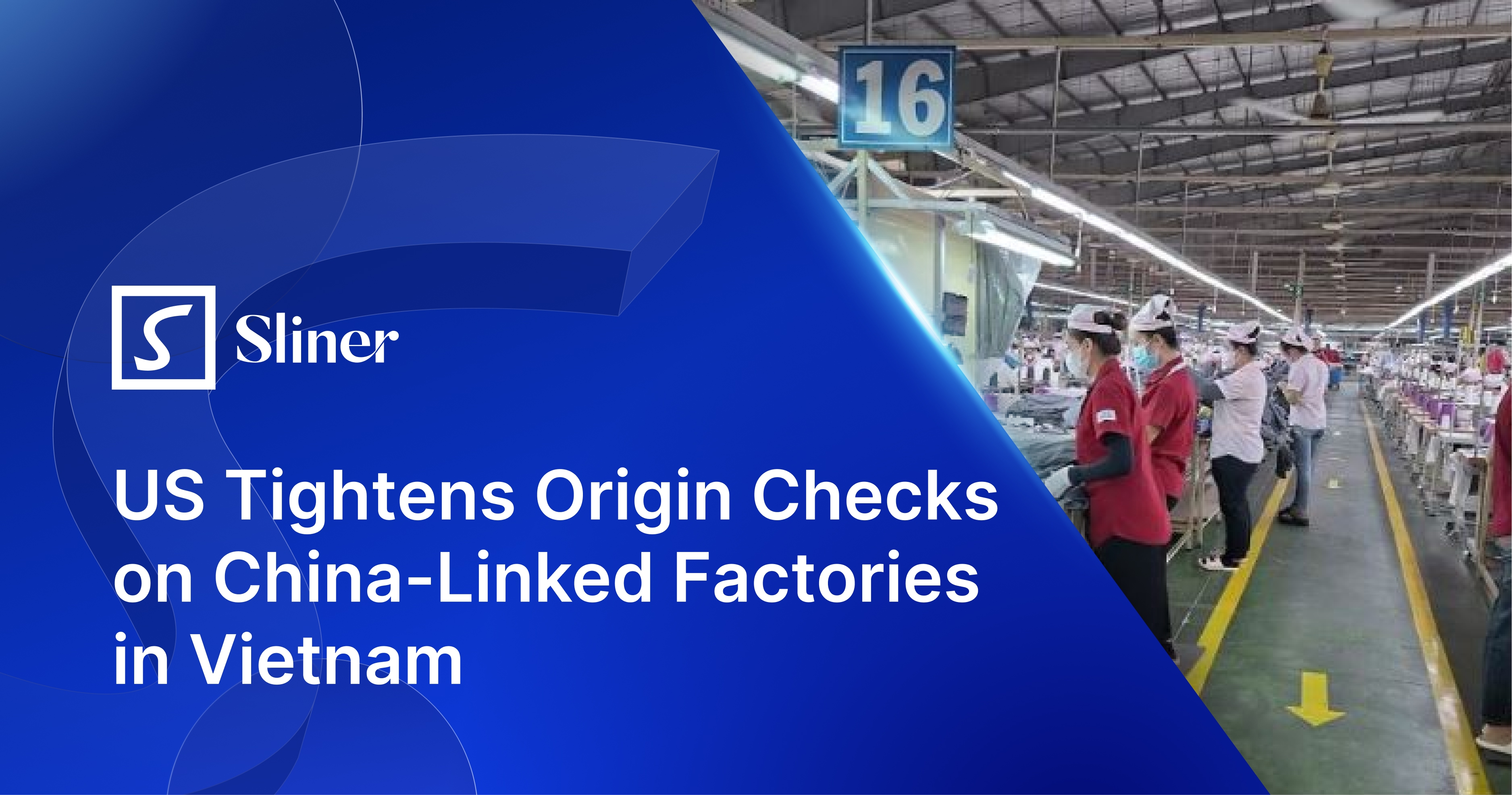
Against that backdrop, a "Made in Vietnam" label is no longer assessed on the documents filed at the port alone. In late July 2026, Reuters cited Bloomberg News reporting that US customs officials had carried out spot inspections at factories in Vietnam with business ties to Chinese partners. Inspectors reviewed documentation, raw material sourcing and the entire production process to establish how much value was genuinely created in Vietnam before the goods were shipped to the United States.
For manufacturers and cross-border e-commerce sellers serving the US market, this is a significant change in how risk must be managed. Valid paperwork is now only the necessary condition; operational data that is consistent with that paperwork is the sufficient condition for proving origin.
This article examines the scope of the inspections, the verification method US authorities are applying, and what businesses should prepare before they receive a request to explain.
1. How the Inspections of China-Linked Factories in Vietnam Unfolded
The move comes as Washington intensifies its review and control of the origin of imported goods. The immediate objective is to establish whether products carrying a “Made in Vietnam” label undergo substantive processing in Vietnam, or only simple finishing steps applied to imported components.

1.1 What the Inspection Teams Examined
According to Bloomberg, US inspection teams conducted an in-depth review of five areas at each of the China-linked factories in scope:
-
Invoicing systems and import-export documentation.
-
Raw material sourcing and supplier relationships.
-
The production process actually running at the plant.
-
The real proportion of value added within Vietnam.
-
Indications of intellectual property infringement, including the use of unlicensed software in the operating line.
The final area is the notable one. The scope of inspection has moved beyond conventional customs matters and now reaches the technology infrastructure running the plant.
1.2 What Has Not Been Disclosed
U.S. Customs and Border Protection (CBP) has not disclosed the identities of the businesses involved, the product categories concerned, or any formal conclusions from the inspections. According to Bloomberg, there is so far no significant evidence that Chinese goods are being illicitly transshipped through Vietnam into the United States. Reuters also stated that it could not independently verify the report, and CBP did not respond to a request for comment.
Businesses should draw a clear distinction here: this is a compliance verification exercise, not a finding of infringement. That said, Bloomberg reports that the inspections are running in parallel with a difficult round of US-Vietnam trade framework negotiations, particularly on transshipment and non-tariff barriers.
2. The Core Shift: From Certificates of Origin to Operational Data
Trade observers see a marked change in US monitoring method. The focus is moving away from reliance on the Certificate of Origin (C/O) and towards reconciliation against actual operating data at the production site. That is why inspections of China-linked factories are being carried out on site rather than through files alone.
|
Criterion
|
Previous monitoring approach
|
Current approach
|
|
Primary basis
|
Documentation and C/O issued by the certifying authority
|
Actual operating data at the plant
|
|
Point of inspection
|
At border gates and ports of import
|
On-site inspection at the production facility in Vietnam
|
|
Central question
|
Is the documentation formally valid?
|
Can the plant produce the declared output?
|
|
Evidence the business needs
|
Import records, C/O, contracts
|
Production logs, electricity consumption data, material consumption norms, warehouse records
|
2.1 The Four Data Sets Being Reconciled
The verification criteria applied by the US side focus on consistency between what is declared and what is observable:
-
Machinery count and the real operating capacity of the line.
-
Workforce size and electricity consumption bills.
-
Input material volumes against finished goods exported.
-
Dwell time of goods in Vietnamese warehouses.
What these four data sets have in common is that they reflect the actual operating capability of the facility rather than what is declared in the paperwork.
2.2 Capacity Gaps Are the Common Failure Point
If a facility has a design capacity of 50,000 units per month but exports 150,000 units over the same period, the business will have to account for the origin of the difference. The gap between production capacity and declared output is the most easily identified risk signal in the entire inspection process.
Available reporting does not set out how each specific discrepancy is treated. What is clear is that the burden of explanation sits with the business, so supporting records need to be ready at the moment they are requested.
3. Signals That Place a Business on the Priority Watch List
According to trade specialists, US authorities will place a business on a priority watch list when the following signals appear:
-
A sharp spike in exports to the US immediately after equivalent Chinese goods were hit with high tariffs.
-
Large-volume imports of near-finished semi-manufactured goods from China.
-
A steep rise in C/O applications while plant capacity remains unchanged.
-
An unusually short interval between material import and finished goods export.
These are all quantitative indicators formed from the business's own declared data. Companies operating China-linked factories should review these four indicators themselves before a regulator raises them.
4. The Legal Backdrop and Sectors Under Watch
4.1 Section 301 Duties and Parallel Investigations
On 23 July 2026, the Office of the United States Trade Representative (USTR) announced final action in its investigations under Section 301 of the Trade Act of 1974 covering 60 economies assessed as having failed to prohibit or effectively enforce bans on imports of goods made with forced labour. Additional duties of 10% or 12.5% took effect at 12:01 a.m. on 24 July 2026. Vietnam falls in the group subject to a 12.5% duty stacking on existing rates, applying to most goods in Chapters 1 to 97 of the Harmonized Tariff Schedule of the United States (HTSUS), other than the categories exempted under the two accompanying annexes. The measure originates from the forced labour provisions and is not directly linked to the outcome of the factory inspections described above. Separately, Vietnam remains under review in distinct investigations concerning intellectual property protection and industrial overcapacity.
4.2 Domestic Enforcement on Intellectual Property
Enforcement against intellectual property infringement is also intensifying in the domestic market. In June 2026, through its working channel with Homeland Security Investigations (HSI), Vietnam's Domestic Market Management and Development Authority (Ministry of Industry and Trade) received information on a network processing Nike-branded footwear in Vietnam for export to the United States. The subsequent inspection at a plant in Ho Chi Minh City identified close to 50,000 pairs bearing suspected counterfeit Nike, Nike Air and Air Jordan marks, far above the roughly 12,000 pairs flagged in the initial information. According to records provided by the business, from the start of 2026 up to the inspection date, it had exported 11 containers of finished footwear to the United States with a total declared value above VND 25.46 billion. The case is being processed.
4.3 High-Risk Sectors
Washington is not expected to impose blanket tariffs across all Vietnamese goods, but to apply in-depth inspection business by business and across high-risk sectors. According to VnEconomy, inspections of China-linked factories therefore concentrate on industries that rely heavily on imported semi-finished inputs:

Source: VnEconomy
-
Electronics and electronic components.
-
Textiles, garments and footwear.
-
Wooden furniture.
-
Steel and aluminium.
-
Solar cells and precision engineering.
The operational consequences for businesses in these groups include longer cargo holds at port, mandatory independent factory audits, or high duty deposits during an investigation. All three hit cash flow directly before any conclusion is reached on the underlying conduct.
5. What Businesses Should Prepare Before an Inspection of China-Linked Factories
Under international trade rules, using raw materials imported from China does not breach origin requirements provided the product undergoes basic processing in Vietnam that changes its essential character and its Harmonized System (HS) code. The challenge today is not eliminating Chinese supply altogether, but evidencing the value created domestically.

5.1 Standardise the Evidence of Substantial Transformation
The substantial transformation principle requires the processed product to have a name, character or use distinct from its input materials. CBP's guidance on rules of origin describes how the agency assesses each specific case. Businesses should hold material consumption norms, production process flow diagrams and an HS code comparison table showing the classification before and after processing.
5.2 Raise the Local Value-Added Ratio
The durable approach is to raise the share of value genuinely created in Vietnam through precision machining, component manufacture, tooling, design and testing. Each localised step both improves the position on goods origin and reduces dependence on a single source in the supply chain.
5.3 Build a Reconcilable Data System
The hardest requirement lies not in any single document but in the ability to cross-reference data sources: procurement, production, warehousing, finance and customs declarations. When the four data sets in section 2.1 are stored separately across multiple systems, assembling one consistent set of supporting records becomes manual work while the goods sit at port.
Cross-border e-commerce businesses can look at the approach used in Sliner's accounting automation service, in which data from multiple sales, payment and operational platforms is consolidated and reconciled automatically on the Genbook platform. A unified supply chain data system materially shortens response time when regulators request an explanation.
6. The Data Must Be Ready Before the Explanation Is Requested
US inspections of China-linked factories in Vietnam are not a barrier aimed solely at businesses sourcing from China, but a test of the operational data quality of the entire export chain. Businesses able to demonstrate consistency between production capacity, input materials and export volumes will clear the review at the lowest cost, whether or not they sit among the China-linked factories concerned.
Sliner works alongside manufacturers and cross-border sellers to review entity structure, and tax obligations across markets, ensuring that origin documentation and financial data hold up against inspection requirements from importing markets. Explore the Global Corporate Structuring & Tax Planning service or contact the Sliner team to assess how ready your current documentation is.