.svg)
On 1 July 2026, the European Union activated two trade measures at once: it removed the customs duty exemption for low-value parcels and replaced its entire safeguard system for imported steel. Both target the same objective: narrowing a trade deficit with China that keeps widening.
For cross-border e-commerce sellers, this is not distant policy news. Every order shipped directly into the EU below 150 euros now carries a new duty and documentation obligation, which changes cost structure, cash flow and the way transactions are recorded. This article sets out what the new e-commerce regulations contain, how they affect operating models, and the steps businesses should complete within the current quarter.
1. What did the EU introduce for e-commerce goods and steel from 1 July 2026?
The European Commission released two separate packages built on the same logic: slow the inflow of low-cost imports that has been eroding domestic manufacturing and retail. Below is what each package contains and when it applies.

1.1 The EU removes the 150-euro de minimis exemption: what actually changes?
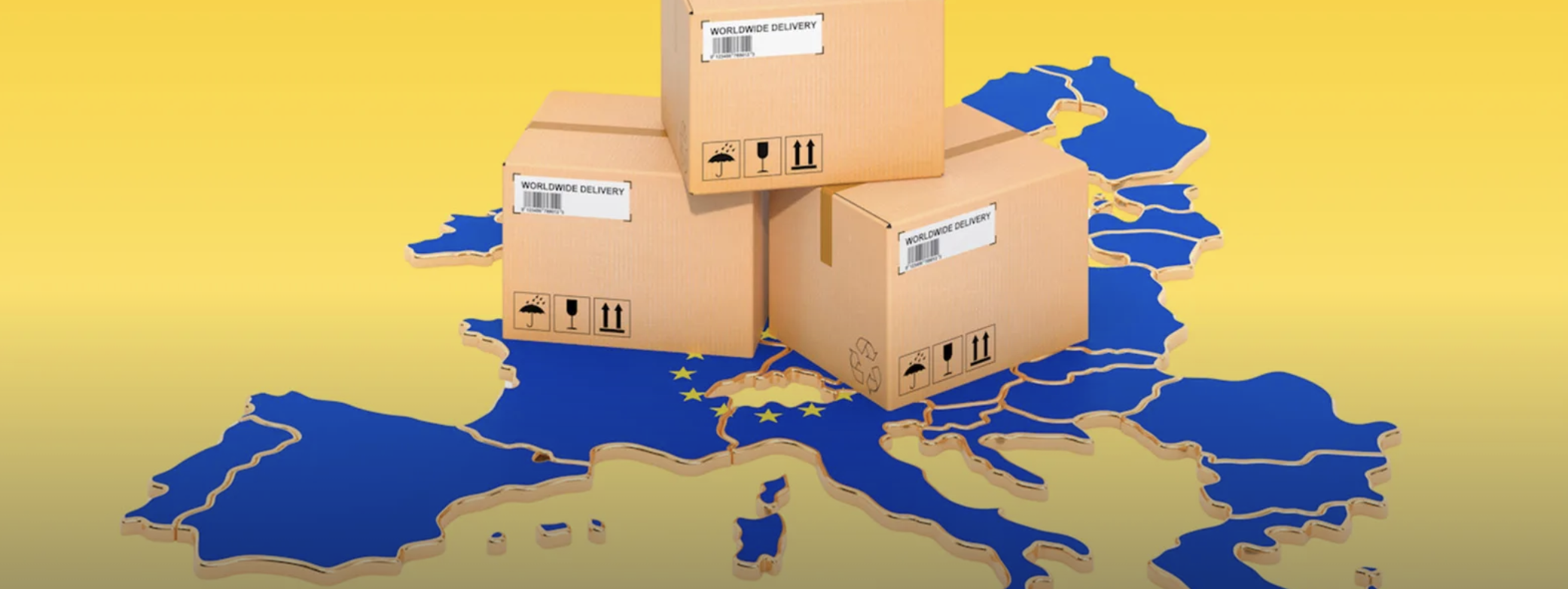
Before 1 July 2026, parcels valued at 150 euros or less entered the EU free of import duty. That mechanism (known as de minimis) has been abolished across all 27 member states and replaced by a flat customs duty on low-value B2C goods.
According to express carrier DHL's guidance on the 2026 EU customs reform, the new charge works as follows:
-
The 3-euro duty applies per line item on the customs declaration, not per parcel. A shipment covering three different HS codes attracts 3 × 3 euros = 9 euros.
-
For shipments declared through IOSS, line items are grouped by 6-digit HS code.
-
For non-IOSS shipments or restricted goods, grouping uses the 10-digit HS code combined with country of origin, so the number of line items — and the total duty — is usually higher.
-
Low-value B2C goods carry this flat charge; low-value B2B goods remain subject to the applicable percentage duty rate or a preferential rate under a trade agreement.
-
IOSS is not used to collect the 3-euro duty, and a handling fee of roughly 2 euros per shipment is expected to apply from 1 November 2026.
Source: DHL
The scale of this flow explains the EU's decision. The European Commission reports that 5.9 billion small parcels entered the EU in 2025, against roughly 1.4 billion in 2022, with about 90% of that trade belonging to Chinese platforms such as Temu and Shein. The United States made a comparable move a year earlier.
1.2 The EU issues new steel rules: an 18.3 million tonne quota and a 50% duty
On the same date, the steel safeguard in force since 2019 expired and was replaced by a new tariff-rate quota framework. As reported by U.S. News, the new rules set tariff-free quotas at 18.3 million metric tons annually and impose an out-of-quota duty of 50% on 26 types of steel imports, double the previous 25% rate.
The regulation also requires more transparency from importers on the "melt and pour" stage, where the steel is melted and cast, to ensure that countries such as China cannot circumvent the protections by shipping into the EU via third countries. Earlier, the EU had introduced new steel tariffs in October to block steel volumes diverted away from the US market by the Trump administration's trade policy.
The EU issued new steel rules against a contracting home industry: crude steel output fell to a record low in 2026 while imports continued to take a larger share of the EU market.
2. Why is the EU tightening e-commerce regulations and steel imports now?
The two packages arriving on the same day is not a coincidence. Both stem from a single pressure: the trade balance between the EU and China has tilted to a level Brussels no longer regards as sustainable.

Source: Cong Thuong Newspaper
2.1 The trade deficit with China: close to 1 billion euros a day
According to U.S. News, the EU's trade deficit with China widened in 2025 to around 360 billion euros (410 billion US dollars), roughly 1 billion euros a day, and continued to rise through 2026. Over the same period, China's global trade surplus approached a record 1.2 trillion US dollars.
That figure is the common denominator behind both measures: low-value parcels and imported steel are two flows feeding directly into the gap.
2.2 Protecting domestic retailers and product safety standards
On e-commerce, Brussels frames the case on two grounds: restoring fairness in tax obligations for European retailers competing against duty-free imports, and quality control, given that a material share of low-cost direct imports fails to meet EU safety standards.
2.3 Global steel overcapacity and Chinese subsidies
On steel, the European Commission stated that the new rules are designed to protect EU plants and jobs from the damaging impacts of global overcapacity on a strategically crucial European industry.
Criticism in Brussels and beyond centres on China's subsidies for steel production, said to undercut steel industries stretching from Germany's Ruhr valley to Kyushu Island in Japan, according to U.S. News.
2.4 What does this mean for sellers?
The new e-commerce regulations are not a temporary defensive measure but a structural change in how the EU manages imports. When the driver of policy is a trade balance rather than an isolated case, near-term reversal is close to impossible. The same trend has already played out in the United States and is likely to spread to other markets.
3. Risks Vietnamese businesses should note when exporting to the EU: rules of origin and EVFTA
Beyond rising import costs into the EU, Vietnamese businesses face another notable risk: control over rules of origin. This factor can directly affect eligibility for tariff preferences and the ability to keep exporting into the EU market.
Speaking to Cong Thuong Newspaper in 2026, Nguyen Thi Hoang Thuy - Director General and Head of the Vietnam Trade Office in Sweden, also covering the Nordic markets, said the EU is closely monitoring the risk of Chinese goods being redirected to Europe after the impact of US tariffs. The categories under scrutiny include steel, electronic equipment, solar panels and wind turbines.
This is not the first time the EU has applied trade defence measures. In 2017, when the United States restricted steel imports from China, surplus volumes shifted to the European market and the EU deployed safeguard measures under WTO rules. The new steel framework effective 1 July 2026 is regarded as a tighter step in that same mechanism.
For Vietnamese businesses, the largest risk is Chinese goods transiting Vietnam to disguise origin before export to the EU in order to claim tariff preferences under the EU-Vietnam Free Trade Agreement (EVFTA). EVFTA allows many Vietnamese products to enjoy reduced or zero duties provided rules of origin are fully met. Should origin fraud occur, however, the EU may step up inspections, tighten the conditions for preferential treatment, or even apply trade defence measures against goods from Vietnam.
According to Nguyen Thi Hoang Thuy, exporters should focus on four groups of measures to reduce this risk:
-
Maintain tight control over the supply chain and secure the origin of goods.
-
Prepare complete origin documentation, ready for inspection by customs authorities or partners.
-
Monitor changes in EU trade policy regularly to adjust export strategy in time.
-
Build competitiveness on product quality and added value rather than relying on tariff advantages alone.
For e-commerce businesses selling into the EU, these requirements must be reflected directly in operating procedures. Origin records, purchase contracts, import documents and customs declaration data must align on every shipment. That alignment is also the foundation for meeting the EU's new rules while retaining EVFTA preferences and limiting risk at clearance.
4. Four direct effects on cross-border sellers
4.1 How do cost of goods and landed cost change at SKU level?
The 3-euro charge per line item is a fixed cost, not proportional to order value. On a product priced at 10-15 euros it erodes margin severely; on a 120-euro order it is almost immaterial. The result is that profitability is reshuffled across the catalogue rather than reduced evenly.
4.2 Direct-from-factory shipping loses its advantage
Selling models built on sending individual small parcels straight from China or Vietnam to EU consumers relied largely on the de minimis exemption. Without it, the cost gap against bulk imports and EU warehousing narrows considerably.

4.3 Heavier declaration, duty and documentation obligations
The new e-commerce regulations bring every parcel into the formal declaration regime. Each shipment now requires a full customs declaration, accurate HS classification and consistent valuation data. Any mismatch between declared data, commercial invoices and marketplace revenue becomes direct exposure during a tax or customs review.
4.4 Spillover risk for goods with steel content
The steel rules currently apply to raw material categories, but the EU has scheduled an assessment in mid-2027 on extending scope to downstream goods with significant steel content. Sellers in housewares, tools and metal accessories should track that date.
5. What should businesses do after the EU's new rules? Four actions for the next 90 days
The EU's e-commerce regulations are already in force, so the work is not about waiting for further guidance but about re-measuring the financial impact and adjusting the selling model.
5.1 Rebuild the landed cost model per SKU
Recalculate delivered cost for every listing under two scenarios: parcel-by-parcel shipping and consolidated import. Any category showing negative margin after the new charge needs a price adjustment, repackaging into higher-value bundles, or withdrawal from the EU market.
5.2 Evaluate consolidated import and EU warehousing
Importing in bulk through an EU entity shifts the duty obligation from thousands of individual transactions to a handful of clearances. In exchange, the business must handle VAT registration, warehousing and local reporting obligations — a corporate structuring decision, not merely an operational one.
5.3 Standardise documentation and accounting reconciliation
As duty and customs charge lines multiply, manual reconciliation in spreadsheets stops being viable. Order data, marketplace fees, shipping costs and import duties need to resolve into a single source of record. This is the problem Genbook and Sliner's accounting automation service address through transaction-level automated reconciliation.
5.4 Review entity structure and tax obligations
Selling directly from a Vietnamese entity to EU consumers and operating through an EU entity produce two entirely different tax profiles. This review should conclude before the Q4 peak season.
6. Accounting treatment as import costs rise
Import duties and the fixed customs charge attach to the goods and should be allocated to cost of goods sold rather than lumped into selling expenses. Misclassification inflates reported gross margins and leads to mispriced listings.
Three minimum principles:
-
Allocate duties and customs charges to each shipment, then down to SKU level by value or unit count.
-
Track the fixed 3-euro charge per line item separately to measure its true impact on low-value categories.
-
Reconcile customs documentation against marketplace revenue monthly rather than letting it accumulate to year end.
Businesses running multiple entities or selling across several marketplaces should review their corporate structuring and tax planning alongside standardising the books.
7. New e-commerce regulations require a new operating model
The removal of de minimis and the tightening of steel imports are not a short-term shock but the end point of a cross-border selling model built on zero duty cost. Businesses that recalculate the cost of goods, choose the right import structure and clean up their accounting data will protect margins; those that keep the old model will watch profits erode order by order.
Sliner works with cross-border e-commerce sellers to reassess entity structure, tax obligations in export markets and the system for recording import costs under accounting standards. When e-commerce regulations in the EU change, the response has to be built on category-level figures rather than assumptions.
To assess how the new e-commerce regulations affect your current model, review Sliner's Corporate structuring and tax planning service or contact the Sliner team for direct advice.
Data sources: U.S. News, Cong Thuong Newspaper