.svg)

Amazon recently announced two major retail innovations: Amazon Now, its 30-minute delivery service, and Alexa Shopping, an AI-powered shopping assistant. For Amazon sellers, these are more than product updates. They signal a future where order volume, transaction speed, and operational complexity will increase faster than most businesses can manage with manual accounting and reconciliation.
This article explores how these developments could affect Amazon sellers' bookkeeping, financial reconciliation, and cash flow management, and what businesses should do to prepare before their accounting processes become a bottleneck.
1. What Amazon Sellers Need to Know About the Future of Shopping on Amazon
Amazon is transforming how customers discover and purchase products. Instead of relying solely on keyword searches, shoppers are increasingly interacting with AI to receive personalized product recommendations and shopping assistance.
In May 2026, Amazon officially combined Rufus: its AI shopping assistant used by more than 300 million customers in 2025, with Alexa+: the company's next-generation personal AI assistant available across hundreds of millions of devices. The result is Alexa Shopping, a unified AI-powered shopping experience integrated directly into Amazon's platform.

Source: Amazon News
With Alexa Shopping, customers can ask questions directly in the search bar, get shopping guidance tailored to their needs, compare multiple products side by side, check up to 12 months of price history, and let AI automatically track deals, build carts, and set up recurring orders. Rather than simply displaying a list of products, Amazon is moving toward helping customers make smarter purchase decisions based on context and personal preference.
Alongside this, Amazon also introduced the Agentic Shopping Assistant through the AWS Generative AI Innovation Center: a platform that lets businesses build their own AI shopping assistants, combining product data, business rules, and brand identity to deliver a personalized shopping experience.

According to Amazon News, more than 300 million customers used AI shopping assistants over the past year, and in 2025 alone this technology generated nearly $12 billion in incremental revenue. This shows that AI is no longer just a supporting feature: it is becoming a core part of the shopping journey on Amazon, opening up significant changes in how sellers manage sales data, operations, and accounting.
2. Notable New Alexa Shopping Features: Amazon's New AI Shopping Assistant
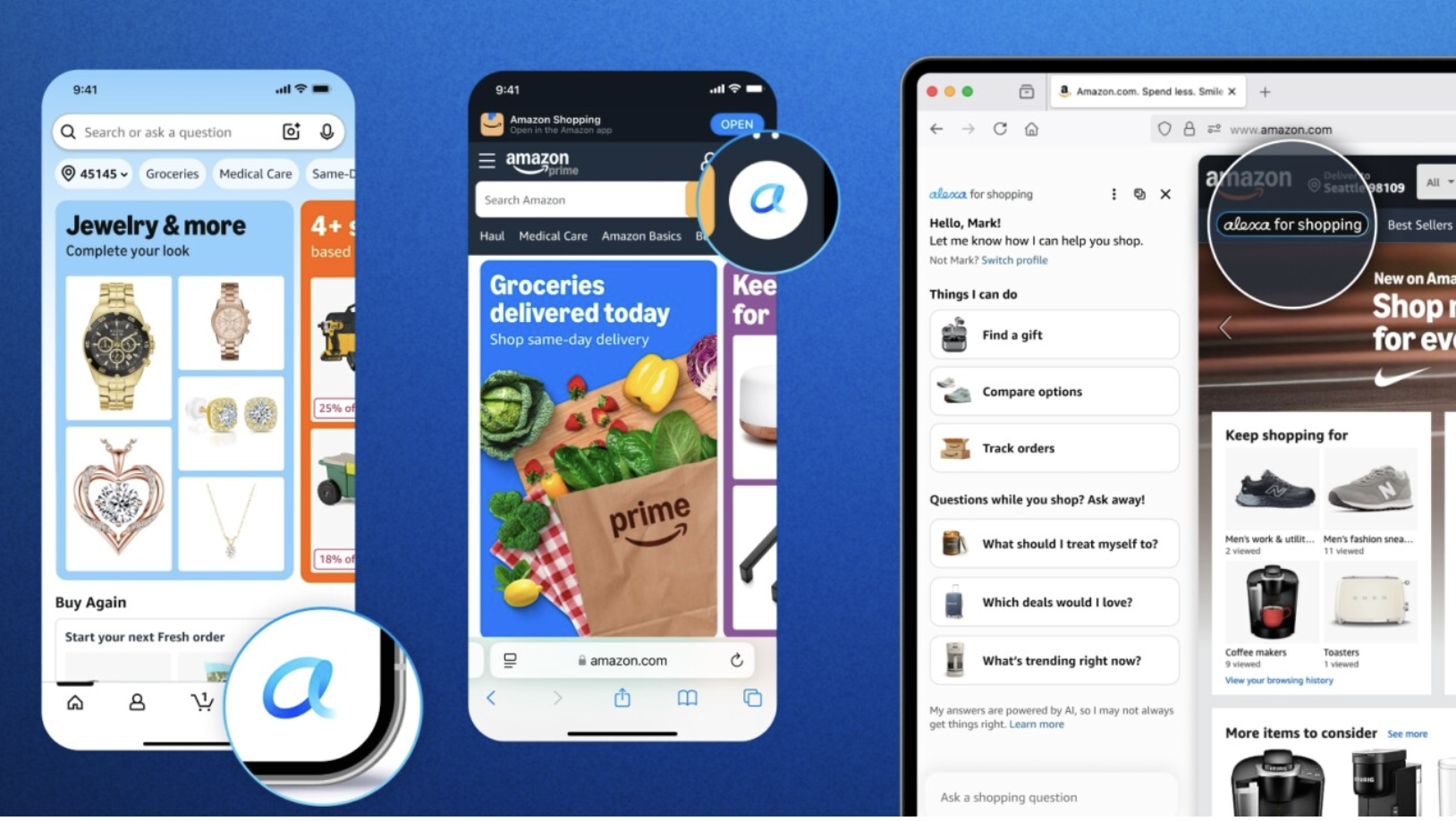
Alexa Shopping is free for all Amazon customers in the US, requires no Prime membership or Echo device, and is available on the Amazon Shopping app, website, and now the full shopping experience on Echo Show.
Some notable new features for Amazon sellers, according to Amazon News:
- Ask questions directly in the Amazon search bar: customers can ask about products, compare items, check order history, or raise shopping-related questions and get answers from Alexa Shopping right in the search box.
- Compare multiple products: AI builds a comparison table across products based on features, price, and reviews to support purchase decisions.
- AI Overview: displays an AI-generated summary on search results and product detail pages, helping customers quickly grasp key information before buying.
- Price history: lets customers view a product's price movement over up to 12 months.
- Scheduled Actions: customers can set AI to automatically track prices, add items to the cart, send purchase reminders, or carry out one-time or recurring purchase actions based on preset conditions.
- Buy for Me: an AI agent can complete a purchase on the customer's behalf from eligible brand websites outside Amazon via Shop Direct, using their saved shipping address and payment method.
- AI-managed cart: Alexa Shopping can retrieve previously purchased items or add multiple products to the cart through conversational commands.
- Personalized shopping experience: remembers a customer's preferences, needs, and details to offer more relevant recommendations.
- Shopping Guide creation: AI builds a personalized shopping guide for big-ticket categories or products, pulling together information from Amazon and related sources to help customers decide.
Source: Amazon News
For Amazon sellers, the rise of AI agents: agentic AI capable of taking action on a customer's behalf, is creating an entirely new shopping model. Instead of customers actively searching and placing orders themselves, AI can automatically track prices, find deals, add items to the cart, or complete a purchase on a set schedule or once a product hits a target price.

This means part of order volume can now originate through AI agents rather than through traditional search or advertising flows. Sellers therefore need to track this revenue source separately to properly assess business performance, optimize marketing, and reconcile accounts more accurately.
3. What Should Amazon Sellers Prepare For in the AI Era?
The growth of Alexa Shopping, AI agents, and automated shopping features doesn't just change consumer behavior: it also sets new requirements for how sellers manage their finances and accounting. As transaction volume rises, data becomes more fragmented, and fees keep changing, manual revenue recording and reconciliation will increasingly fall short.
To adapt to this trend, Amazon sellers in the US and globally should prepare on a few fronts:
Reassess the current accounting system. Sellers should make sure their system can fully capture all fees generated on Amazon — FBA fulfillment fees, storage fees, advertising fees, returns, adjustments, and other deductions. Relying only on Settlement reports or manual data entry makes it hard to pin down the real profitability of each order and each SKU.
Strengthen data reconciliation capabilities. As Amazon keeps adding new shopping features, transaction volume and the data generated grow with it. Businesses need a regular reconciliation process across orders, payments, Settlement reports, inventory, and the books, to catch discrepancies in revenue, costs, or platform fees early.
Track performance by revenue source. As AI plays a bigger role in the shopping journey, sellers should build reporting that can break down revenue by campaign, conversion channel, or customer segment. This helps businesses accurately judge marketing performance, optimize budgets, and make decisions based on data rather than total revenue alone.
Push forward with accounting and financial reporting automation. As the business scales, processing data by spreadsheet becomes time-consuming and error-prone. Automating data collection, transaction reconciliation, and financial reporting cuts manual workload and gives management timely numbers for decision-making.
As AI increasingly becomes part of the shopping journey on Amazon, competitive advantage will come not just from selling more, but from the ability to manage financial data accurately and in real time. Sellers who invest early in accounting and reconciliation systems will be better positioned to control profit, optimize cash flow, and scale as Amazon continues to build out its AI capabilities.
4. Sliner Helps Amazon Sellers Adapt to the New Way of Operating
The pace of operations on Amazon is now outrunning most sellers' manual reconciliation: automating accounting is no longer optional. It's what it takes to keep margins stable.
Sliner works alongside businesses selling on Amazon to rebuild multi-channel accounting and reconciliation workflows, so financial data keeps pace with reality even as Amazon keeps rolling out new services. To improve operational efficiency, Sliner uses Genbook: automated bookkeeping software built for e-commerce businesses. Genbook automatically syncs data across sales channels, reconciles revenue, standardizes journal entries, and supports fast reporting: cutting manual work, reducing errors, and freeing up the accounting team to focus more on financial analysis and decision support.
Learn more about Sliner's accounting automation service, or get in touch to have your current accounting setup reviewed before Amazon Now and Alexa Shopping scale further.