.svg)
1. Overview of accounting and taxation for game companies
The gaming industry is one of the specialized sectors, where revenue, business models, and financial structures differ significantly from traditional businesses.
Game companies often operate on digital platforms, generating revenue from multiple countries and various sources such as in-app purchases, advertising, or game distribution.
Understanding accounting practices and tax types for game studios is an important factor that helps businesses both comply with corporate law and optimize taxes effectively.
For game companies receiving global revenue, the accounting and tax system is not only a management tool but also a foundation for sustainable growth.
2. Revenue accounting in game companies
The revenue of a game company usually does not come from a single source but includes multiple streams of cash flow.
Common revenue sources include selling in-game items, charging for game downloads, or revenue from distribution platforms.
According to accounting guidelines, when revenue arises, the enterprise needs to recognize it according to the principles:
- Record receivables from customers or payment platforms
- Record service revenue
- Record value-added tax if applicable
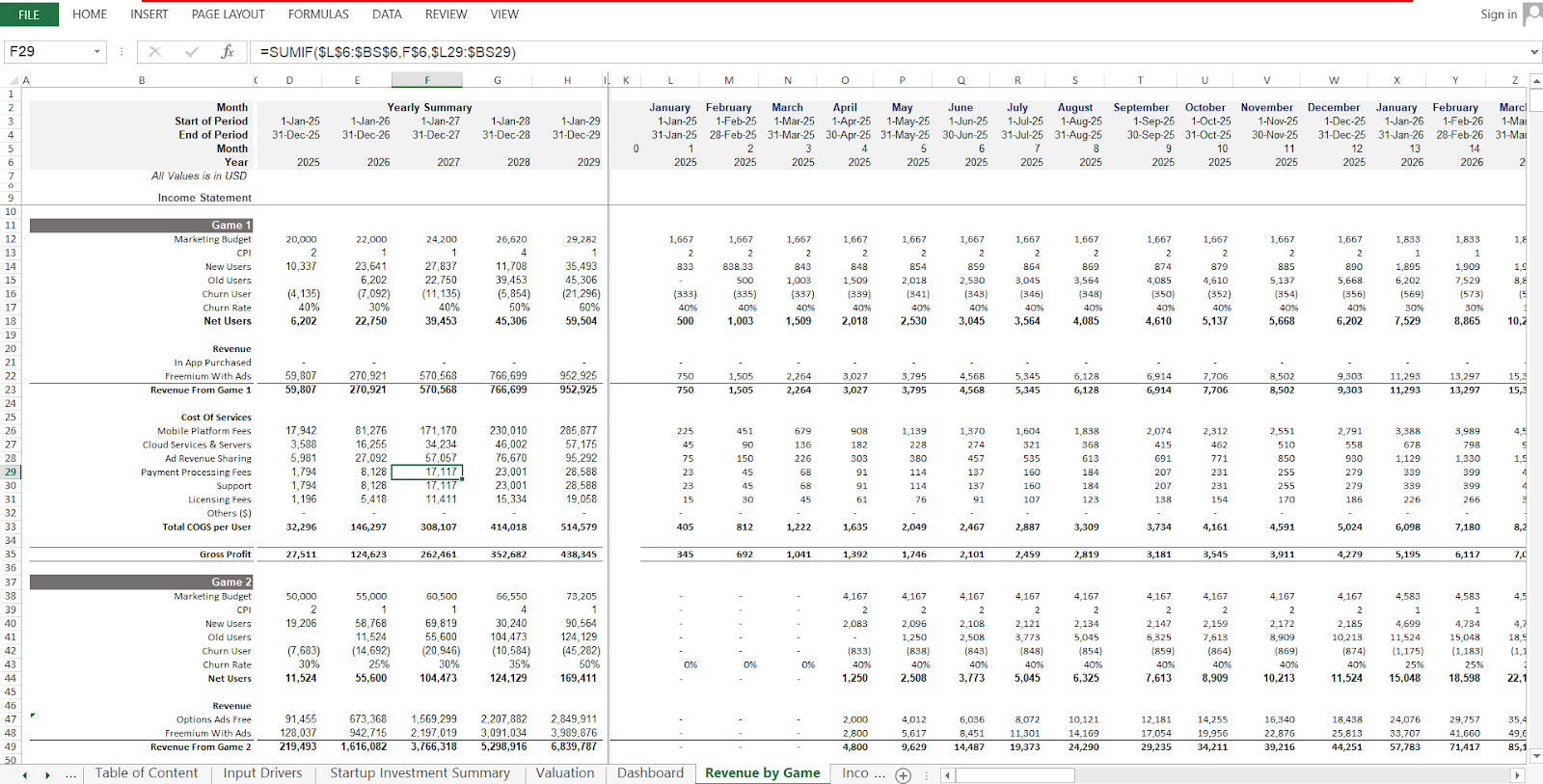
Source: Mobile Game Development Financial Model Excel Template
Specifically, the enterprise will use accounts for customer receivables, service revenue accounts, and output VAT accounts for accounting purposes.
3. Key taxes for game companies
For taxes for gaming companies, there are three important types of taxes that businesses need to pay special attention to.
3.1. Value-Added Tax (VAT)
According to regulations, software products may be exempt from VAT, as they are considered technology products.
This helps gaming companies reduce output tax obligations, but at the same time, they cannot deduct input VAT.
3.2. Corporate Income Tax
This is the most important tax directly affecting a business's profit. The software production sector, including games, can enjoy many significant tax incentives.
Specifically, businesses can:
- Be exempt from tax for the first 4 years
- Reduce tax by 50 percent for the next 9 years
- Apply a preferential tax rate of 10 percent for 15 years
These incentives only apply when businesses meet the software product conditions according to regulations.
3.3. Personal Income Tax
For personnel in gaming companies, personal income tax also needs to be strictly managed.
Depending on the type of contract, businesses will apply different tax rates.
- For official employees, the progressive tax rate is applied portion by portion.
- For collaborators or freelancers, a fixed tax rate of about 10% on income can be applied.
This is especially important in the gaming industry, where flexible working models are very common.
4. Role of intellectual property

Another specific factor of the gaming industry is the connection between IP and finance. Games are not only products but also intellectual property that can generate long-term revenue.
- Copyright registration helps businesses establish ownership rights and create a legal basis for revenue recognition.
- Furthermore, IP for game studios also affects cost allocation, asset recognition, and long-term tax strategy.
Conclusion
Accounting and taxation in gaming are complex but offer optimization opportunities. From revenue recognition to IP management, all aspects impact profitability. Vietnamese studios must understand regulations and build strong strategies to grow sustainably.
![[Event Recap] VGDA C-LEVEL Private Cafe Hanoi](https://cms.sliner.sg/storage/uploads/blogs/MgYnUuDGjwQg2wNnmOqyy2iB2nTGxaXYwHcVKlGb.jpg)