PayPal
Get Your BusinessReady To Grow!
Sliner
By Admin UserFebruary 23, 2026 at 5:27 PM GMT+7

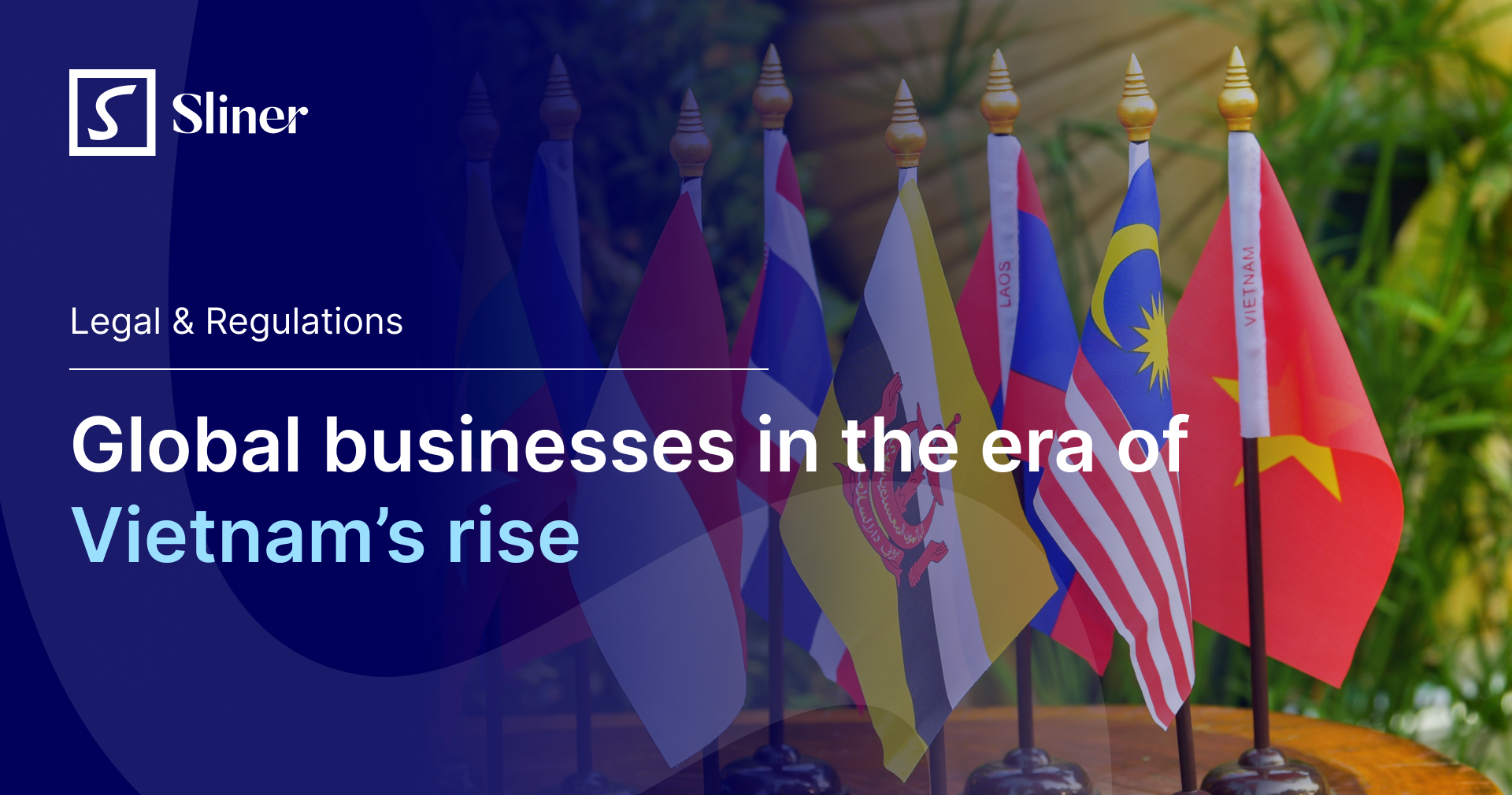
Global businesses in the era of Vietnam’s rise

Vietnam’s addition to the EU tax blacklist is not a failure — it is a signal that the international business environment is undergoing a fundamental shift, where compliance is no longer optional but a prerequisite for survival.

Global businesses in the era of Vietnam’s rise

Sliner’s Perspective

Vietnam’s addition to EU Annex I should be viewed in a broader context: it is part of an irreversible global trend toward tax transparency and cross-border corporate governance. The Vietnamese government has responded swiftly and in the right direction. The question is not whether Vietnam will adapt, but whether your business is ready.


ONE EVENT, MANY SIGNALS

On February 17, 2026, the EU Council formally added Vietnam to Annex I — the blacklist of non-cooperative jurisdictions for tax purposes — after the OECD Global Forum rated Vietnam “Non-Compliant” on the Exchange of Information on Request (EOIR) standard. This is a notable event, but what is more notable is how Vietnam responded.

Within hours of the news breaking, Ministry of Foreign Affairs Spokesperson Pham Thu Hang issued an official statement: Vietnam did not contest or deny the findings, but rather accepted and proactively moved to remediate. The government had already amended the Law on Tax Administration, the Enterprise Law, and issued Decree 168/2025/ND-CP during the review process itself, while simultaneously developing a National Action Plan to implement the OECD’s recommendations.

This was not a passive response. It is evidence of a nation that has clearly defined its development trajectory.


VIETNAM IN THE ERA OF “RISING UP”: THE BROADER CONTEXT

To properly understand the blacklist event, it must be placed within the broader context of what is unfolding in Vietnam. This is not an isolated policy change but rather a fundamental institutional transformation.

In 2025, the Politburo issued four resolutions that General Secretary To Lam called the “Four Pillars” for the new era: Resolution 57 on science, technology, and innovation; Resolution 59 on comprehensive international integration; Resolution 66 on reforming lawmaking and enforcement; and Resolution 68 on private sector development. These are not ceremonial documents — they are being rapidly institutionalised into concrete laws and policies.

Resolution 66, in particular, is regarded as the “breakthrough of breakthroughs” — aimed at building a unified, transparent, and predictable legal system that protects property rights and freedom of business. Resolution 68 has been likened to a “declaration launching the second phase of Doi Moi,” elevating the private sector from being “recognised” to being “protected, encouraged, and promoted as a leading driver of development.”

Alongside these, the “1,000 Exemplary Enterprises” initiative and the “Go Global” programme were launched to support Vietnamese businesses in expanding into international markets. Lump-sum taxation for household businesses is being abolished from 2026, driving formalisation and transparency.

The World Bank, in its report “Vietnam 2045: Breaking Through on Institutions” (July 2025), emphasised that Vietnam needs an “institutional big push” to achieve high-income status by 2045. Tax transparency reform and international information exchange are an inseparable part of that push.


Critical Context

On January 29, 2026 — just 19 days before the blacklisting — Vietnam and the EU formally upgraded their relationship to a Comprehensive Strategic Partnership — the highest tier of Vietnam’s diplomatic framework. Vietnam became the first ASEAN nation to achieve this status with the EU. European Council President António Costa declared: “At a moment when the international rules-based order is under threat from multiple sides, we need to stand side by side as reliable and predictable partners.” This demonstrates that the blacklisting is a technical matter, not a strategic issue in bilateral relations.


GLOBAL TRENDS: TRANSPARENCY IS NO LONGER OPTIONAL

Vietnam’s situation does not exist in a vacuum. Globally, the international business environment is undergoing a fundamental shift in transparency and compliance requirements. What was previously considered “nice to have” has become a mandatory condition for participation in the global economy.

Three Irreversible Trends

1. International tax standards are becoming increasingly stringent

The OECD Global Forum, with 172 members, has helped uncover EUR 135 billion in additional tax revenues since 2009. The 15% global minimum tax (Pillar Two) is being implemented across more than 40 countries. Loopholes in information exchange, transfer pricing, and offshore structures lacking real economic activity are being closed worldwide.

2. EU defensive measures are “automatic”

When a jurisdiction is placed on the blacklist, measures such as non-deductibility of payments, increased withholding taxes at source, and mandatory DAC 6 reporting are triggered at the Member State level — without requiring any additional political decision. This is a rules-based mechanism, not a discretionary one.

3. Global supply chains demand real economic substance

This trend extends far beyond traditional tax concepts and is reshaping how businesses participate in international commerce.

Understanding Economic Substance Through Three Layers

Layer 1 — Substance from a tax perspective

Tax authorities worldwide are increasingly requiring every entity within a corporate structure to demonstrate real economic activity — decision-making personnel, office premises, management functions — rather than merely serving as an “address” for routing funds. The EU, Singapore, Hong Kong, and the UAE have all tightened these requirements in recent years. An entity lacking real economic activity may be disregarded by tax authorities (look-through), with profits reallocated to where genuine activity takes place, or subjected to General Anti-Avoidance Rules (GAAR).

Layer 2 — Substance from a supply chain perspective

This trend is more powerful than many realise. Multinational corporations increasingly require supply chain partners to meet standards of corporate governance, tax transparency, and legal compliance — not because they are concerned about your taxes, but because your risk becomes their risk. Specifically: if a supplier is located in a jurisdiction on the EU blacklist, payments to that supplier may lose tax deductibility in the EU or trigger mandatory DAC 6 reporting — increasing the cost of engaging with that supplier. Corporations may simply choose an alternative supplier in a more compliant jurisdiction. In parallel, the EU’s Corporate Sustainability Due Diligence Directive (CSDDD) requires large EU companies to verify and ensure that their entire supply chain complies with environmental, human rights, and governance standards — creating a cascading effect that reaches businesses not directly subject to EU law.

Layer 3 — Substance as a competitive advantage

This is a point that many businesses have yet to recognise. In the new environment, businesses with transparent structures, strong governance, and clear financial reporting will be preferred by international partners, gain access to better financing, and experience less disruption when policies change. “Compliance” is no longer a cost burden but a genuine competitive advantage. Businesses with real economic substance will be the partners of choice — not the partners left behind.


A Noteworthy Paradox

Vietnam’s efforts to remedy its EOIR deficiencies in order to exit the blacklist will simultaneously enhance the international tax information exchange capabilities of the Vietnamese tax authorities. This means that corporate structures lacking real economic substance belonging to Vietnamese businesses themselves will also become easier to detect. Reform to meet international standards will not only affect government agencies — it will directly impact every business with cross-border operations.


THE MESSAGE FOR GLOBAL BUSINESSES

If the blacklist event is placed within the context of Vietnam’s “Four Pillars” of reform and its 2045 ambitions, a clear picture emerges: Vietnam’s direction is toward international transparency and compliance, and the pace of transformation will be faster than many expect.

This presents both opportunities and challenges for Vietnamese businesses operating globally:

What Businesses Need to Recognise

       The era of “good enough” structures is over. Corporate structures established hastily, without long-term strategy, and lacking real substance — structures that were “good enough to open a bank account” or “good enough to sell on Amazon” — will face mounting risk as tax authorities across multiple jurisdictions tighten their scrutiny.

       Transfer pricing is not just a concern for large corporations. Under Decree 132/2020 and the new provisions in Decree 320/2025, Vietnam’s tax authorities are paying increasing attention to transfer pricing examinations for small and medium enterprises with cross-border transactions.

       Ultimate beneficial ownership (UBO) disclosure requirements will become more stringent. One of Vietnam’s five OECD-identified deficiencies is its nascent beneficial ownership framework. Addressing this will lead to clearer reporting requirements for the true ownership of all business types in Vietnam.

       EVFTA and trade agreements do not protect weak structures. Vietnam’s participation in EVFTA, CPTPP, or RCEP does not shield businesses from EU tax defensive measures. Trade agreements and the tax blacklist operate on two different legal planes. Businesses need to understand this distinction clearly.


THE COST OF INACTION

There is a truth that everyone must acknowledge, yet few are willing to confront:

The Rule of Compliance Costs

The cost of getting it right from the start is always many times lower than the cost of remediation after problems have materialised. A properly designed international business structure may cost a few thousand dollars. A tax audit, transfer pricing dispute, or loss of deductibility can cost hundreds of times more — not to mention the losses in time, reputation, and business opportunities.


Common situations seen globally:

       Non-US businesses selling in the US establish companies in the United States, Singapore, or Hong Kong solely for an address and a bank account, with no strategy for cash flows, transfer pricing, or financial reporting.

       Structures comprising multiple entities across multiple jurisdictions but with no clear business rationale for why each entity exists.

       No transfer pricing documentation (TP documentation), unable to explain why profits are allocated as they are across entities.

       Tax filing is treated as “enough” — with no separate management financial reporting to truly understand business performance.

Each of these situations creates compounding risk — invisible in the short term, but with severe consequences when scrutiny begins.


SLINER’S PERSPECTIVE: GETTING THE STRUCTURE RIGHT FROM THE START IS THE MOST SUSTAINABLE STRATEGY

At Sliner, we emphasise a consistent principle with every client: a global business structure is not a cost — it is a foundation. Like the foundation of a building, if done correctly from the outset, you will never need to think about it again. If done poorly, every floor added increases the risk.

Our approach rests on three pillars:

1.     Understand international standards, not just domestic law. An effective business structure must function well not only under Vietnamese law, but also under the standards of the OECD, the EU, the United States, and other jurisdictions where the business operates. The blacklist event is clear proof: regulations in one jurisdiction can produce consequences in another.

2.     Design structures with real economic substance. Every legal entity within a structure must have a legitimate business reason to exist, carry out real economic activity, and be capable of withstanding scrutiny from tax authorities in any jurisdiction. “Shell companies” have no place in this new world.

3.     Prepare for the future, not just the present. A well-designed structure does not merely address today’s needs but is adaptable when policies change. The EU blacklist event will not be the last disruption — and businesses need structures flexible enough to avoid being caught off guard by every shift.


A CALL TO ACTION

We are witnessing a defining moment in Vietnam’s economic history. The government is driving reform at unprecedented speed. The international environment is tightening compliance requirements. The Vietnam–EU Comprehensive Strategic Partnership opens significant trade cooperation opportunities, but with commensurate compliance expectations.

For Vietnamese businesses currently operating globally or planning international expansion, this is the moment to ask serious questions about the transparency and sustainability of your business operations:

1.     Does my current structure have real substance? Does each entity have a legitimate business reason to exist?

2.     Can I explain the cash flows and profit allocation between my entities to a tax authority?

3.     If tax policy in any jurisdiction changes, is my structure flexible enough to adapt?

4.     Do I understand the reporting obligations in every jurisdiction where I operate?

5.     For new ventures: do I already have a strategic architect for my global business structure?

If any of these questions does not yet have a clear answer, that is a signal to act.

Not tomorrow, but right now.


CONCLUSION

Vietnam’s addition to the EU tax blacklist is not an endpoint but a starting point for a new chapter. With the nation’s “rising up” agenda and its determination to reform institutions, Vietnam will assuredly move toward international transparency and compliance. The only question is: will your business lead, or follow?

Sliner Consulting, with a global mindset and deep understanding of international standards, stands ready to accompany businesses on this journey. Because in the world of global business, getting it right is not a cost — it is insurance.


Disclaimer: This article is published by Sliner Consulting for informational and analytical purposes. It does not constitute legal or tax advice. Businesses should consult qualified advisors appropriate to their specific circumstances. Information reflects the regulatory environment as of February 22, 2026.

Sliner Consulting Strategic Advisory for Global Businesses


Suggested Topics:Thương mại điện tửVietnam
S

Sign up for the latest insights

Receive in-depth analysis, market trends, and the latest updates on finance and technology every week.

Join 5,000+ finance professionals. Unsubscribe anytime.